Plant Highlights
Plant Highlights
-
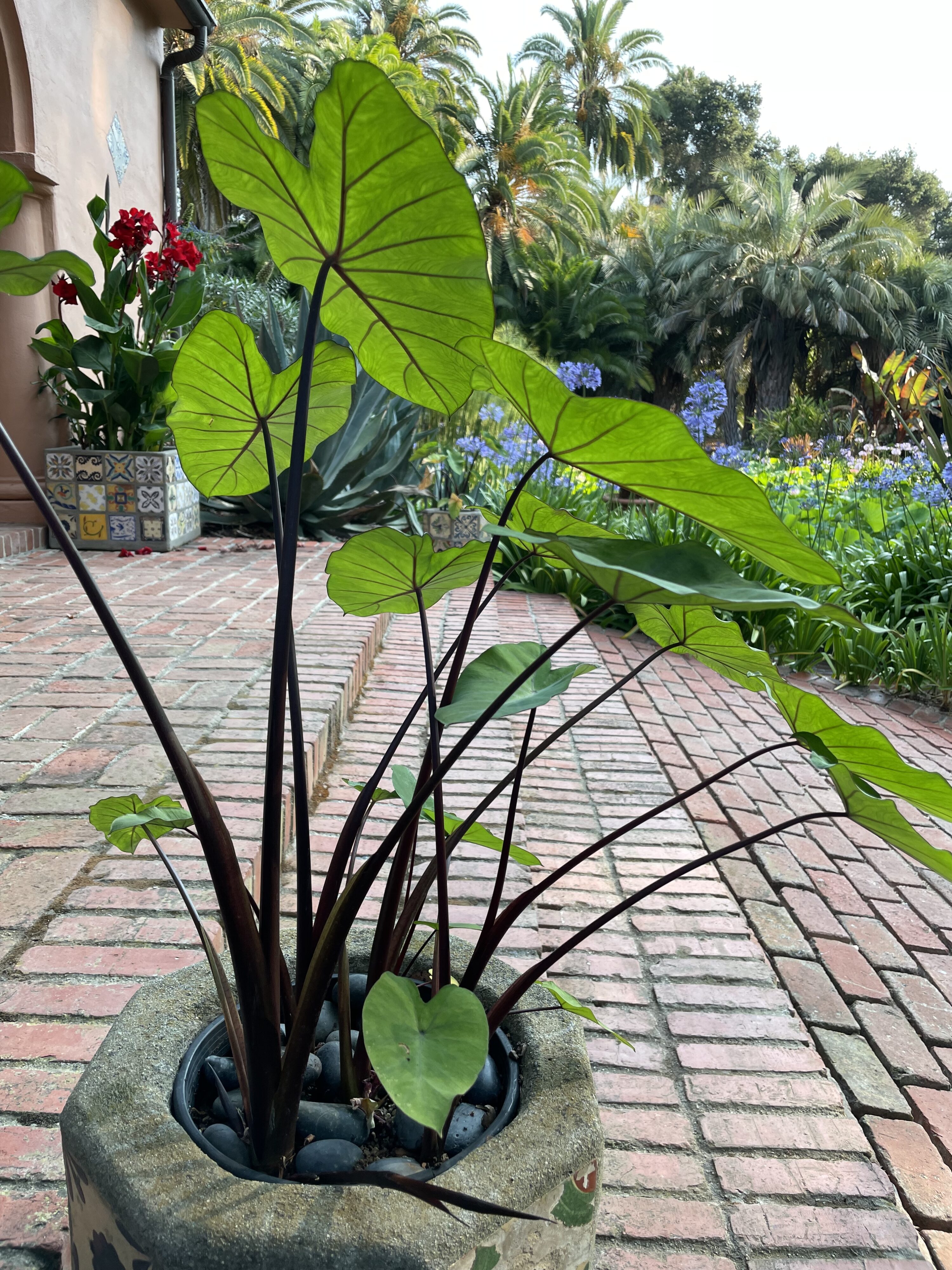
Colocasia esculenta ‘Fontanesii’
black taro
Highlight Month:
July
Nativity:
Garden Origin
Growth Habit:
This taro exhibits spectacular purple-black petioles topped with green heart-shaped leaves. If provided with abundant nutrients and water these tender perennials can reach up to 7’ tall. Flowers are bright yellow with a papaya-like scent but rarely seen.
Growing Requirements:
This flexible plant is happy in a pot or the ground and can even withstand being submerged up to 12” in water. It prefers light to part shade and is hardy to USDA Zone 7 with mulching.
Features:
Both the leaves and corms of taro are edible but toxic when raw due to the presence of calcium oxalate crystals. Steaming, boiling, and steeping can minimize the toxin.
Where at Lotusland:
Look for Colocasia esculenta ‘Fontanesii’ in the Water Garden bogs and in pots in front of the Bath House at Lotusland.

-
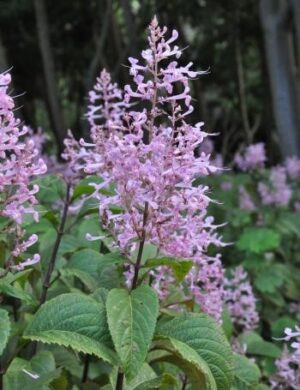
Plectranthus ecklonii ‘Erma’
Highlight Month:
September
Nativity:
Garden Origin
Growth Habit:
Plant this Plectranthus for showy pink flowers in the fall! This species is native to eastern South Africa and is usually found along forest margins and streambanks.
Growing Requirements:
‘Erma’ is best grown in partial shade and has pink flowers, unlike the usual purple of the straight species. Prune it back hard in the winter to maintain a small size, otherwise the plant will reach over 10’ tall.
Features:
The cultivar ‘Erma’ is named after the wife of legendary South African plantsman, Ernst van Jaarsveld, who specializes in Lamiaceae and even has a compact caudiciform Plectranthus named in his honor (P. ernstii). Our plants originally came from Kirstenbosch National Botanical Garden in Cape Town, South Africa.
Where at Lotusland:
Lotusland has plantings of Plectranthus ecklonii ‘Erma’ in the Cycad Garden (near the entrance to the Tropical Garden) and Insectary Garden.

-
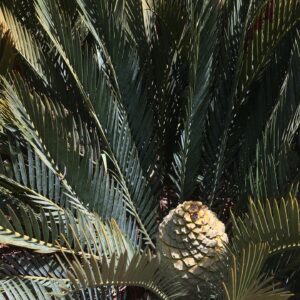
Encephalartos lehmannii
Karoo cycad
Highlight Month:
April
Nativity:
This cycad hails from the Eastern Cape of South Africa where it grows on semi-arid sandstone slopes.
Growth Habit:
Mature plants can reach 4-6’ tall and form a clump with pleasing blue leaves with recurved tips.
Growing Requirements:
E. lehmannii can withstand dry conditions once established in the landscape, prefers full sun, and is frost tolerant (25-30°F).
Features:
The name honors Professor Johann Georg Christian Lehmann, a 19th century German botanist, who published several papers on cycads and described the genus Encephalartos.
Where at Lotusland:
Cycad Garden

-
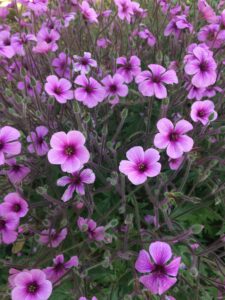
Geranium maderense
Madeira Island geranium
Highlight Month:
February
Nativity:
Island of Madeira off the northwest coast of Africa
Growth Habit:
It is a biennial and produces a flush of tropical-looking leaves about 3’ wide during its first year, and a massive many-branched inflorescence with bright pink flowers its second year.
Growing Requirements:
This geranium can tolerate dry, clay soils and is adaptable to sun or shade.
Features:
Flower stalks and sepals are covered in purple glandular hairs that prolong its spring interest. Be sure to leave the lower leaf stalks because they form a mound of stilts to prop up the stem.
Where at Lotusland:
Fern Garden- where both the straight species and the cultivar ‘Alba’, a white-flowered form grow.

-
Aloe marlothii
mountain aloe
Highlight Month:
January
Nativity:
Native to mountainous regions of Mozambique, Zimbabwe, Botswana, and eastern South Africa.
Growth Habit:
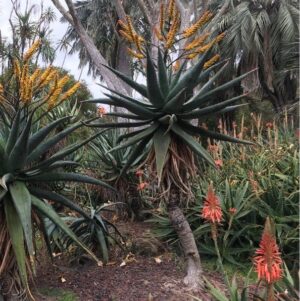
This tree-like aloe grows to 10’ tall with large spiny leaves. Old leaves persist to cover the trunk in an attractive “skirt.”
Growing Requirements:
Full sun, well-drained soils. Hardy to 20°F.
Features:
Orange flowers are borne in the winter months on a distinctively branched horizontal inflorescence.
Where at Lotusland:
Aloe Garden

-
Xanthorrhoea quadrangulata
Australian grass tree
Highlight Month:
December
Nativity:
South Australia
Growth Habit:
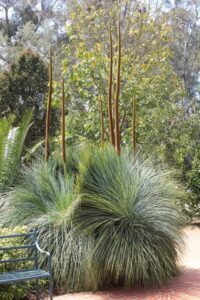
Grass-like foliage covers its thick woody trunk that can reach 6’ tall. Mature plants produce a 6-12’ stalk bearing small white fragrant flowers in the spring. Slow-growing.
Growing Requirements:
Full sun, drought tolerant.
Features:
The scientific name is derived from the Greek ‘xanthos’ (yellow) and ‘rheo’ (to flow), in reference to the resin exuded out of the trunk. The resin is used by Aboriginal Australians for spear-making, patching, and as a varnish. The specific epithet comes from the Latin ‘quadra’ (four) and ‘angulata’ (angular), describing the four-sided cross section of the leaf.
Where at Lotusland:
Australian Garden near the Visitor’s Center

-
Ficus carica ‘Panache’
Striped Tiger Fig
Highlight Month:
October
Nativity:
Garden Origin
Growth Habit:
Ficus carica ‘Panache’ will grow 12-20’ tall but can be pruned for ease of picking.
Growing Requirements:
Full sun, will need supplemental water in extended periods of drought.
Features:
This fig cultivar produces unique variegated fruit with yellow and green stripes! New stems and leaves display a slight variegation as well. Striped tiger figs ripen late in the season compared to other fig selections and our plant at Lotusland is just now producing tasty edible fruit with strawberry-pink, sweet tasting interior flesh. Fig “fruits” are a type of multiple fruit called a syconium, a fleshy, hollow structure lined internally with multiple flowers. Tiny pollinating wasps enter the syconium through an ostiole, the opening on the underside, to pollinate the flowers which later develop into single-seeded fruits (drupelets) that line the interior.
Where at Lotusland:
Deciduous Orchard
-
Agave atrovirens
pulque agave, maguey
Highlight Month:
September
Nativity:
Mexico (Oaxaca, Puebla, and Veracruz)
Growth Habit:
This is the largest of all Agave species and can reach 6-8’ tall with a spread of 8-12’. When mature, the plant will flower and eventually die, but not before producing a 15’ asparagus-like inflorescence with bright yellow flowers.
Growing Requirements:
Sun, well-drained soils. Drought tolerant.
Features:
A. atrovirens it is one of the agaves fermented in the production of pulque and mezcal. The specific epithet, atrovirens, references its dark green leaves (from the Latin ‘ater’= black/dark and ‘virens’= green).
Where at Lotusland:
Dunlap Garden
-
Cleyera japonica
sakaki
Highlight Month:
August
Nativity:
Japan, Korea, China
Growth Habit:
Cleyera japonica, is a broadleaf evergreen shrub. In the wild, this species grows into a small tree, but when cultivated tends to develop a shrubbier habit, reaching 8-10’ tall by 6-10’ wide. New growth emerges a reddish bronze and fades to dark green. Fragrant creamy white flowers appear in mid-summer.
Growing Requirements:
Requires regular irrigation, well drained soils, and light shade.
Features:
It is considered a sacred tree to Japanese mythology and Shinto ritual and is used to construct tamagushi, an offering made of a sakaki branch decorated with strips of washi paper, silk, or cotton.
Where at Lotusland:
Japanese Garden
-
Nageia nagi
nagi, Asian bayberry
Highlight Month:
July
Nativity:
China, Japan, Taiwan
Growth Habit:
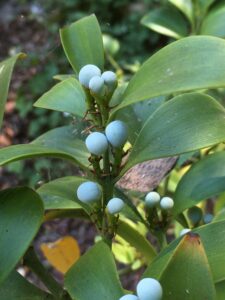
Trees will reach 30-50’ high and 15-25’ wide with a pyramidal shape. Evergreen leaves remain leathery and glossy and trunks display attractive bark exfoliating in patches.
Growing Requirements:
Prefers to grow in well-drained loams but is tolerant of poor soils and drought once established.
Features:
This broadleaf conifer is a member of the podocarp family (Podocarpaceae). Members of this species are dioecious, meaning female cones and male catkins are produced on separate plants. This species is uncommon in cultivation.
Where at Lotusland:
Both male and female Nageia nagi can be found in the Japanese Garden at Lotusland.