Plant Highlights
Plant Highlights
-
Ensete ventricosum
Abyssinian/Ethiopian banana, false banana
Highlight Month:
September
Nativity:
This large-scale banana is native to the eastern edge of the Great African Plateau.
Growth Habit:
E. ventricosum grows to 12-20’ in cultivation (30-40’ in habitat) and produces 10-12’ leaves that give a tropical look to the garden. Overlapping leaf petioles form a pseudo-trunk that expands at the base, hence the specific epithet, ventricosum, meaning “with a swelling belly.” This species rarely produces offsets from the base and will die after producing a dramatic inflorescence that takes over a year to develop. Small cream-colored flowers are hidden underneath maroon bracts with female/bisexual and male flowers occurring separately.
Growing Requirements:
This species is hardy to USDA Zones 10-11 but can be moved indoors for the winter in colder climates.
Features:
It is in the same family (Musaceae) as the more commonly cultivated banana but does not make palatable fruits. Instead, the heart of the plant is fermented to produce a variety of food products. The large black seeds are considered a famine food in Ethiopia and are also used to make beads.
Where at Lotusland:
Eight new plants of E. ventricosum were recently added to Lotusland’s Tropical Garden. All are seed propagations from a plant that flowered between August 2020-September 2021. The Water Garden is home to the red-leaved cultivar ‘Maurelii’, which is easier to find in cultivation than the straight species.

-
Salvia guaranitica
anise-scented sage
Highlight Month:
August
Nativity:
Brazil to Northern Argentina.
Growth Habit:
This large and attractive plant blooms mid-summer to fall with blue-purple petals and green to blue-black calyxes. The flowers are popular with hummingbirds and butterflies. Several cultivars available in the nursery trade have been selected for varying flower colors such as ‘Black and Blue’, ‘Argentine Skies’, and ‘Blue Enigma’.
This perennial Saliva can grow over 6’ tall in the Santa Barbara area but can be pruned in spring to branch at a lower height. Leaves are held in an opposite arrangement on the stem, are dark green in color, and have a mild anise-scent with crushed. Spreading underground rhizomes form a large patch and, in more temperate regions, can be overwintered indoors for planting the following season. Stem cuttings are also easy to root.
Growing Requirements:
S. guaranitica is hardy to USDA Zones 8-10, prefers full sun to part-shade, and is moderately drought tolerant once established.
Features:
The genus name, Salvia, comes from the Latin, salvus, meaning “to make safe or healthy” in reference to the healing properties of many sages. The specific epithet, guaranitica, refers to the Brazilian city of Guará, where this species is found.
Where at Lotusland:
At the back of the Cycad Garden.
-
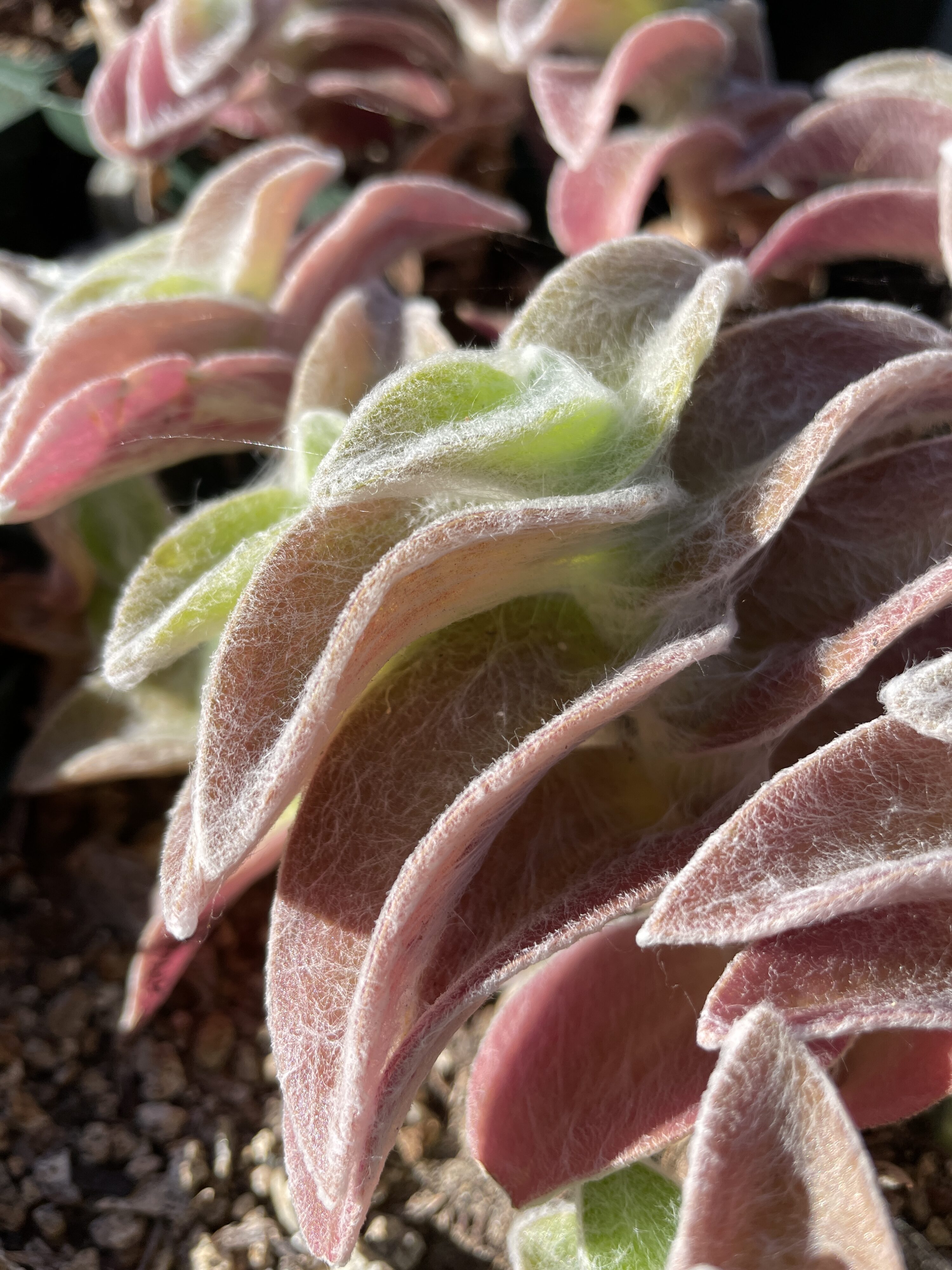
Tradescantia sillamontana
cobweb spiderwort
Highlight Month:
June
Nativity:
Tradescantia sillamontana is native to dry regions of Mexico (Nuevo León).
Growth Habit:
This unique dry-growing Tradescantia has a delightful fuzzy leaf covering that resembles silvery cobwebs. Flowers are magenta and have three petals, typical of plants in the Commelinaceae or spiderwort family. This is a great specimen for containers, hanging baskets, or can be nestled in between rocks in a succulent garden.
Growing Requirements:
When grown in full sun it develops a compact habit and purple coloration to the leaves whereas plants grown in shade tend to be more elongated and greener. It is hardy to USDA Zones 7-10 and will die back to dormant buds in the winter. During this time watering should be infrequent.
Features:
This species was named in 1955 by Japanese-born Mexican botanist Eizi Matuda for Cerro de la Silla, a saddle or chair-shaped mountain, located adjacent to the city of Monterrey, Nuevo León.
Where at Lotusland:
This plant can be found at Lotusland in a pot in the Pavilion Patio and in the Succulent Garden.
-
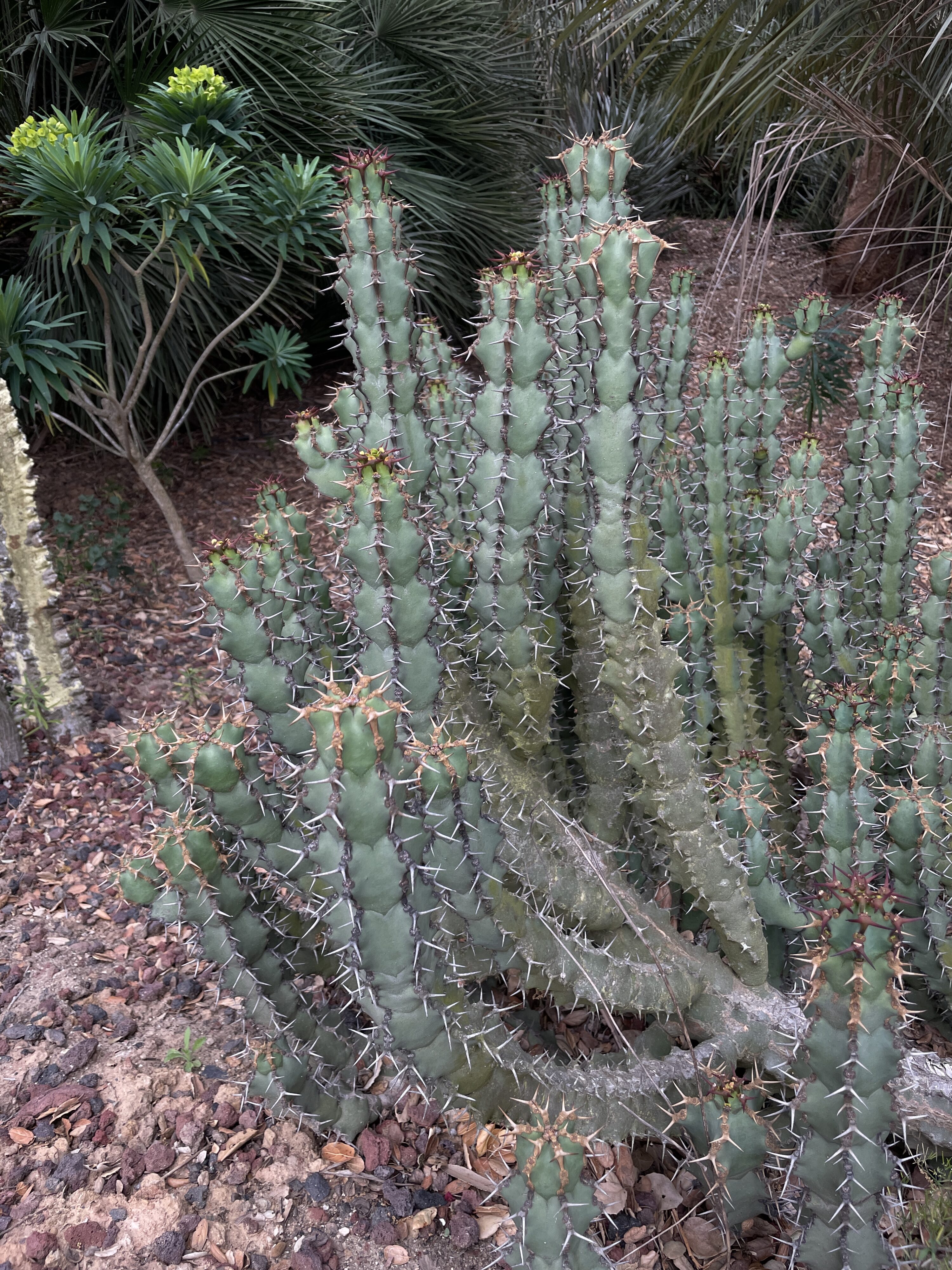
Euphorbia caerulescens
sweet noor, blounoorsdoring, or blue euphorbia
Highlight Month:
May
Nativity:
E. caerulescens is native to South Africa where it grows in an area known as the Noorsveld.
Growth Habit:
It has a rhizomatous habit and forms a 5’ tall dense mass of blue-green segmented stems. The stems have 4-6 faces with rows of paired thorns that emerge brown and mature to grey. Bright yellow flowers standout against the blue stems and are followed by red fruits.
Growing Requirements:
E. caerulescens prefers full sun, well-drained soils, and is very drought tolerant. It is hardy down to 30°F.
Features:
The specific epithet, caerulescens, comes from the Latin, caeruleus, meaning sky-blue. Noors is the Afrikaans name for upright, spiny euphorbia plants. In habitat, local farmers use this species as livestock fodder. After being cut and allowed to wilt for a few days, the irritating latex sap found in the stems is rendered harmless.
Where at Lotusland:
Euphorbia side of the Main Drive
-
Furcraea macdougallii
MacDougall’s century plant
Highlight Month:
April
Nativity:
This Mexican Agave relative is native to Oaxaca, Chiapas, and Puebla where it grows in dry forests at elevations of 2,600 to 3,300 feet.
Growth Habit:
Mature F. macdougallii form a swollen trunk up to 15 feet tall topped with a rosette of thick dark green leaves reaching 7’ in length with curved marginal teeth. This species is monocarpic and will die after flowering. However, the dramatic 20’ inflorescence produces hundreds of bulbils (small plantlets) that can be easily propagated as clones of the parent plant.
Growing Requirements:
This species prefers full sun and has very low water needs.
Features:
F. macdougallii was first described by Eizi Matuda, a Japanese-born Mexican botanist who named this plant in honor of his friend Thomas MacDougall, a Scottish naturalist who studied southern Mexican flora for almost 50 years. MacDougall is credited with discovering this plant in the wild near Tehuantepec in Oaxaca.
Where at Lotusland:
At Lotusland there are three specimens of F. macdougallii near the intersection of the Succulent Garden and Blue Garden. These plants were donated to Lotusland from the International Succulent Introductions (ISI) 1965 distribution via the UC Santa Barbara Greenhouses and planted in 1995.
-
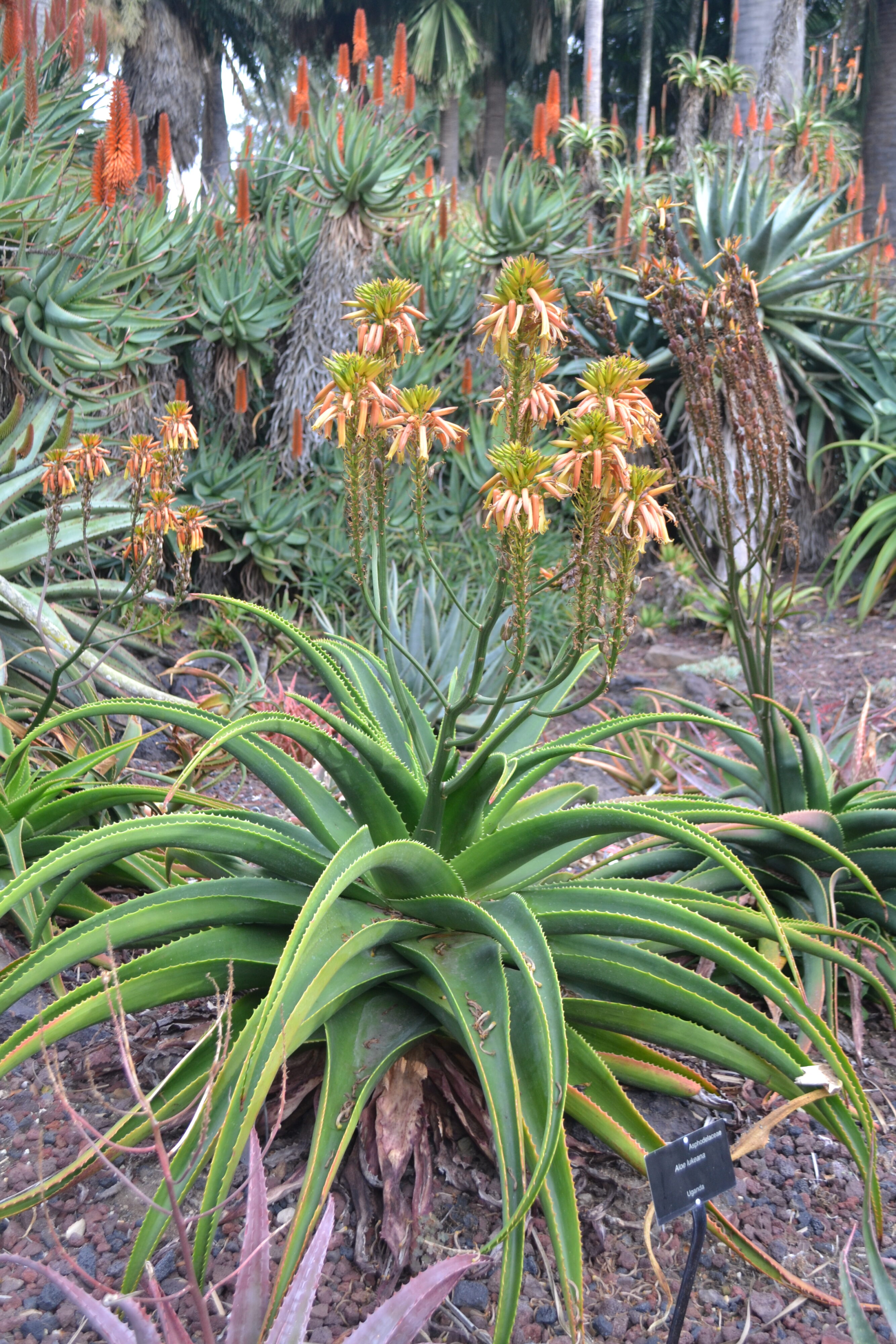
Aloe lukeana
Luke’s aloe
Highlight Month:
February
Nativity:
Aloe lukeana is found in northeastern Uganda and South Sudan.
Growth Habit:
It displays striking red to orange flowers in late summer-early winter that are held upright before becoming pendant. This large solitary Aloe will reach 3-4’ wide and form a decumbent rosette that grows along the ground. This species is relatively new to cultivation but observations in the wild indicate it eventually forms an upright trunk and may branch with age.
Growing Requirements:
Well-drained soils and full sun.
Features:
This Aloe was first described in 2015 by Tom Cole, owner of Cold Spring Aloes, humanitarian/agricultural aid worker, and Lotusland neighbor. It is named in honor of his late brother, Luke Cole, an environmental justice lawyer and conservationist who tragically died while exploring Uganda in 2009.
Where at Lotusland:
Aloe Garden

-
Citrus x junos
yuzu
Highlight Month:
January
Nativity:
Yuzu is an East Asian citrus believed to have originated in central China as a hybrid of Citrus reticulata var. austere (a mandarin orange variety) and Citrus cavaleriei.
Growth Habit:
It is one of the more cold-hardy citrus species and can withstand temperatures down to 10°F. The leaves exhibit a unique broad petiole below the leaf blade and the stems have thorns.
Growing Requirements:
Adaptable to various climates, from tropical to subtropical and Mediterranean. Provide supplemental water throughout the growing season and during dry months.
Features:
There are many varieties of yuzu: hana yuzu (“flower yuzu”, grown ornamentally for its flowers); yuko (a rare yuzu with sweet flesh), and shishi yuzu (“lion yuzu”, grown for its thick knobby skin). The highly fragrant rind and bitter juice are used for drinks and cooking and the essential oils are added to perfumes, lotions, and soaps. Fruits can be used when unripe (green) or ripe (yellow). Yuzu is the main ingredient in yuja-cheong, a Korean marmalade that serves as a base for hot tea. In Japan, whole yuzu fruits are traditionally added to hot baths on the winter solstice.
Where at Lotusland:
Citrus Orchard

-
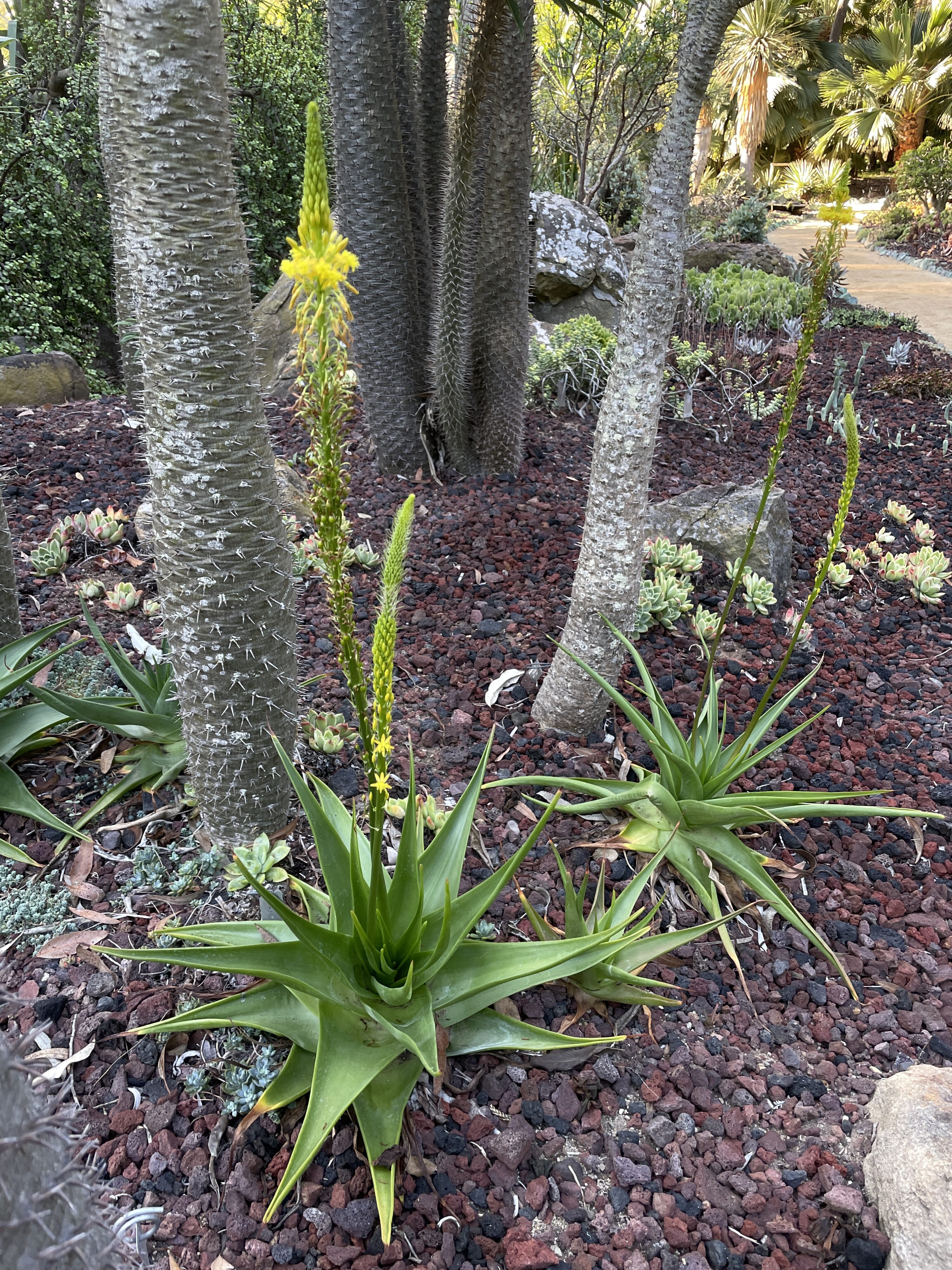
Bulbine natalensis
broad-leaved bulbine, rooiwortel
Highlight Month:
October
Nativity:
This plant is native to KwaZulu-Natal in eastern South Africa where it grows on sandstone cliffs and dry river valleys. It is considered a pioneer species in habitat and will readily colonize disturbed areas.
Growth Habit:
Bulbine natalensis is a soft, spineless succulent that resembles an Aloe. It forms solitary rosettes about 1’ wide and flowers in the late winter/early spring. Flowers are yellow, lightly fragrant, and are held on an unbranched inflorescence 1-2’ above the main rosette. The filaments of the stamens are bearded, making the flowers appear fuzzy.
Growing Requirements:
It is easy to grow in well-draining soil in full sun. Plants usually live for 5-8 years but will seed around the garden.
Features:
The Afrikaans common name for this plant is rooiwortel (red root) in reference to the orange/red color of the lower stem when it is damaged and exposed to light. The sap of this plant is used medicinally and as an aphrodisiac and testosterone booster.
Where at Lotusland:
Bulbine natalensis can be found in the Succulent Garden at Lotusland growing below the Pachypodium.
-
Microgramma vacciniifolia
Highlight Month:
September
Nativity:
M. vacciniifolia is native to moist/wet forests in tropical America (Venezuela and Columbia to Paraguay and Argentina) where it grows as an epiphyte (on other plants) or lithophyte (on rocks).
Growth Habit:
This fern displays attractive long rhizomes covered in brown scale-like hairs and dimorphic fronds. Fertile fronds are slender and develop sori (spore case clusters) on the underside whereas sterile fronds are round-ovate and do not play a direct role in reproduction.
Growing Requirements:
This fern performs well in hanging baskets, terrariums, and can be mounted to pieces of bark. In more arid climates, cultivation may be more successful in the ground where the humidity is higher. It can tolerate brief periods of 30-40°F but is considered tender to semi-tender.
Features:
The genus Microgramma is derived from the Greek mikros (small) and gramme (line), referring to the elongated sori of other members in the genus. Vacciniifolia references leaves in the shape of those in the genus Vaccinium (which includes blueberries, cranberries, and huckleberries).
Where at Lotusland:
This unusual and uncommon fern can be found in Lotusland’s Fern Garden growing in a hanging basket.
-
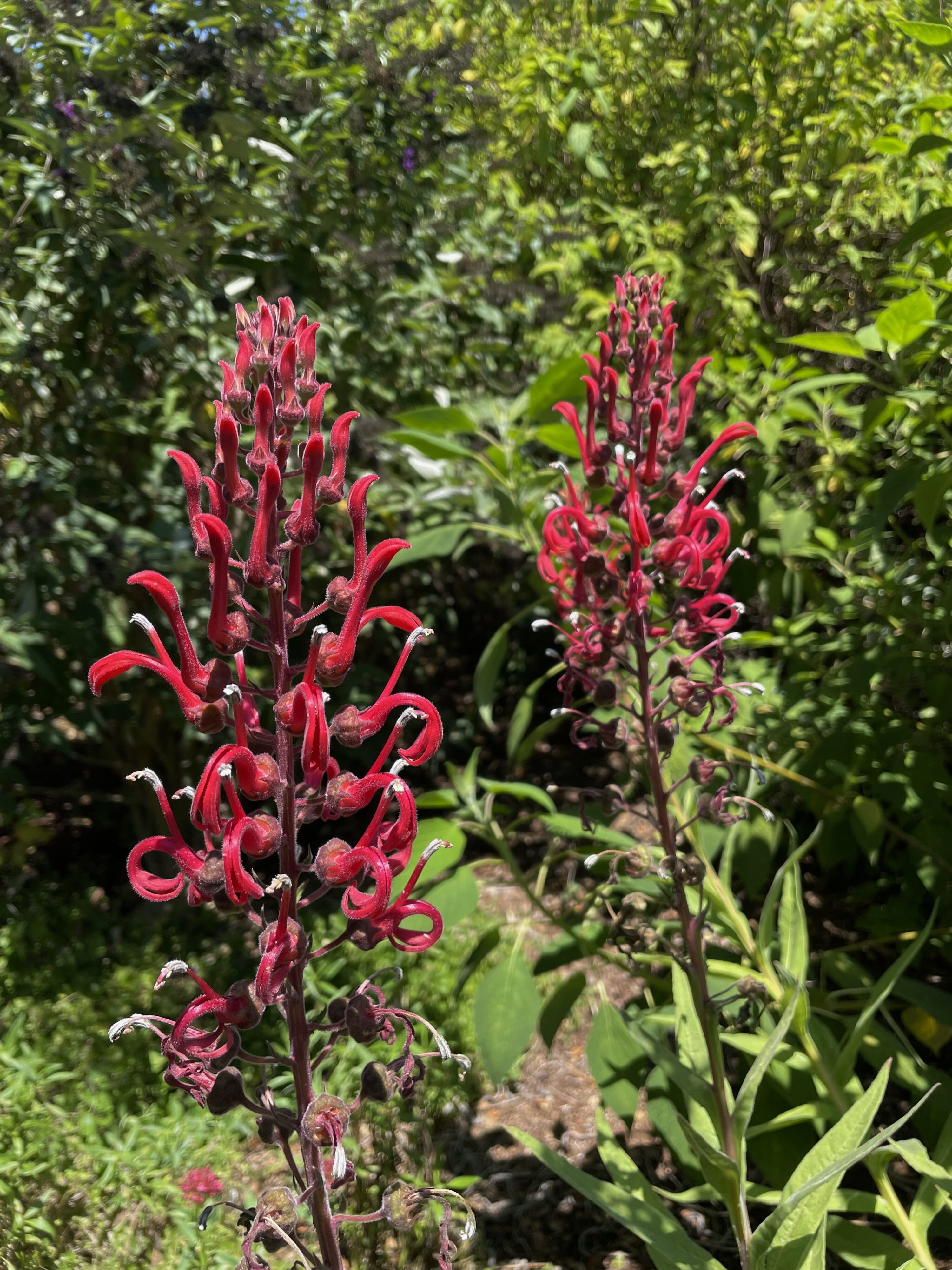
Lobelia tupa
Highlight Month:
August
Nativity:
Chile
Growth Habit:
Perennial that forms a 4’ wide clump and can reach heights of 6-8’. Blooms in mid to late summer and will lightly reseed in the garden if flower stalks are left over the autumn. The bright red flowers attract hummingbirds, bees, and butterflies and its broad grey-green leaves resemble the tobacco plant.
Growing Requirements:
L. tupa prefers full sun, minimal summer water after its first year, and is winter deciduous.
Features:
Use caution when handling this plant as it may irritate the skin and eyes. Contains the alkaloid lobeline which has similar effects upon the nervous system as nicotine.
Where at Lotusland:
Insectary Garden