Plant Highlights
March
-
Lecanopteris scandens
fragrant fern
Highlight Month:
March
Nativity:
New Zealand, eastern Australia, and Lord Howe Island
Growth Habit:
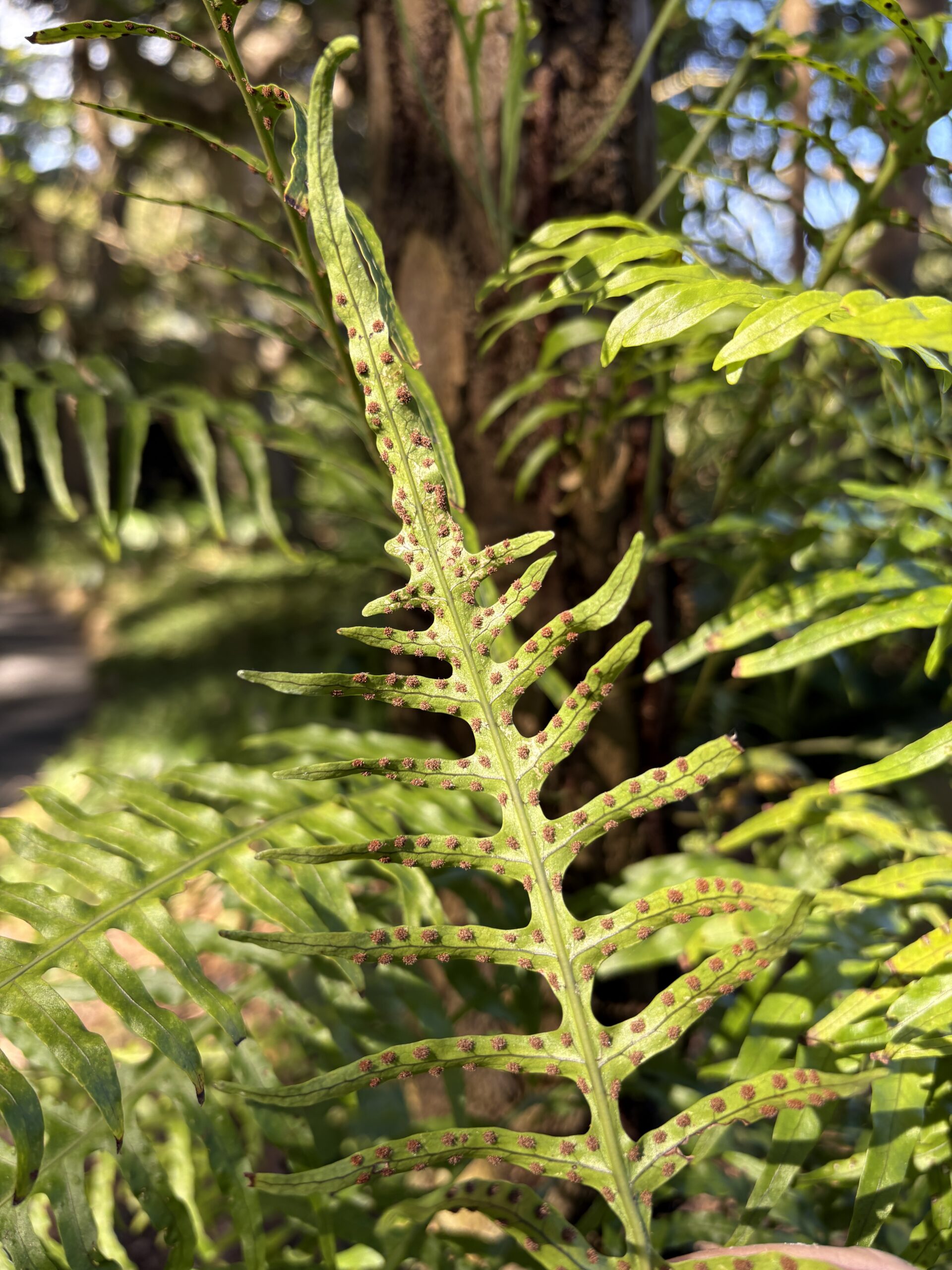
It can grow either terrestrially or epiphytically as seen in Lotusland’s Fern Garden where it ascends the trunk of an Australian tree fern (Cyathea cooperi) and equally thrives in the soil below.
Lecanopteris scandens is referred to as the fragrant fern because the fronds emit a musky odor when crushed. The evergreen fronds are pinnatifid (cut half to three-fourths of the way to the rachis) with deep u-shaped sinuses. Fronds on juvenile plants may be entire (lacking lobes). Ferns reproduce by spore, produced in sporangia, which are held in clusters called sori. The sori on L. scandens are round. The genus name comes from the Greek lekane, meaning basin or dish, referencing the concave sori found in some species in the genus, and pteris, meaning fern. The specific epithet, scandens, references its climbing habit.
Growing Requirements:
Lecanopteris scandens has medium light and moisture needs and can also grow in a hanging basket.
Features:
The Pteridophyte Phylogeny Group lists this species under the genus Lecanopteris, but it was previously listed under Microsorum, Dendroconche, and Polypodium. The genus Lecanopteris previously only included the “ant ferns” that house colonies of ants in inflated rhizomes, but it was expanded in 2021 to include 24 accepted species.
Lotusland’s accession of L. scandens was acquired in 1998 as Microsorum scandens from Barbara Joe Hoshizaki (1928-2012), co-author of the Fern Grower’s Manual and former professor of biology at Los Angeles City College and curator of ferns at the UCLA herbarium.
Where at Lotusland:
Fern Garden
-
Halleria lucida
African honeysuckle, tree fuchsia, white olive, umbinza, notsung
Highlight Month:
March
Nativity:
The range of H. lucida extends from South Africa to Ethiopia and into Yemen. The genus Halleria belongs in the Stilbaceae family and contains five accepted species with two endemic to Madagascar.
Growth Habit:
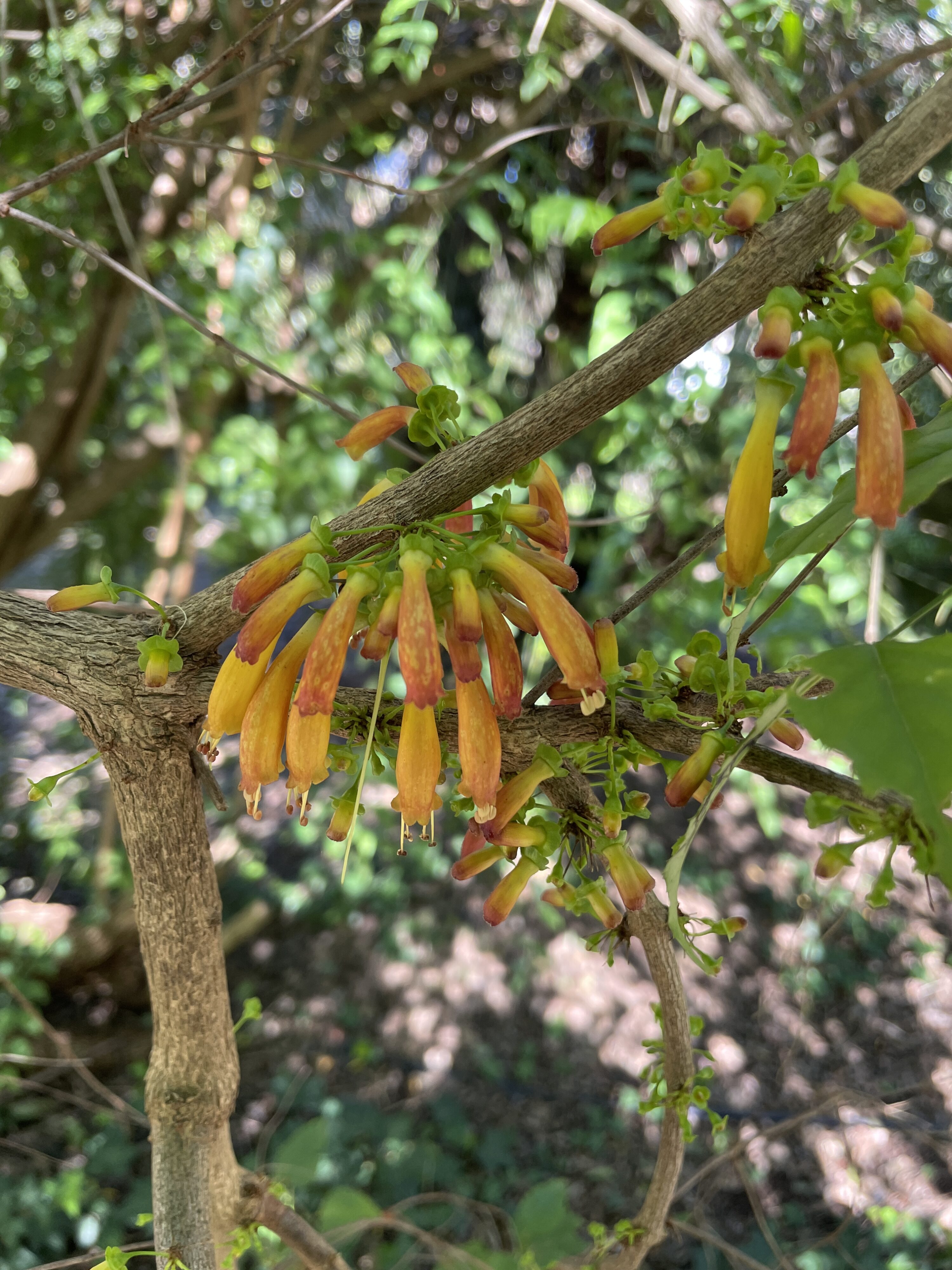
Halleria lucida is a small evergreen tree/multi-stemmed shrub. It produces masses of red to orange bilabiate (2-lipped) flowers borne cauliflorously on the trunk and in the leaf axils of younger branches. Watch out for hummingbirds vying for access nectar when this plant is in bloom from late winter to summer. The fruits are green, marble-sized, and mature to a purple-black color. They are edible but have a sickly-sweet astringent quality. This species produces trailing branches with arching stems and the bark is greyish brown with shallow longitudinal fissures.
Growing Requirements:
H. lucida can reach heights of 8-15 feet in the garden but can be coppiced to maintain a shrubby appearance. It is hardy to USDA Zones 9a to 11 and grows best in full to part sun and with regular water.
Features:
In habitat, it is pollinated by sunbirds, other nectar-feeding birds, and insects. The Zulu people use the plant for treating skin and ear conditions and it is believed to have protective properties against evil and witchcraft. They drive stakes of Rhamnus prinoides (shiny-leaf buckthorn) covered with a mixture of H. lucida ash and crocodile fat around their village perimeters. Carl Linnaeus named the genus Halleria in 1753 in honor of 18th century Swiss scientist Albrecht von Haller (1708-1777). The specific epithet, lucida, comes from the Latin adjective lūcidus, meaning bright and shining, in reference to the glossy green opposite leaves.
Where at Lotusland:
Lotusland’s plants were propagated from seed donated by Kirstenbosch National Botanical Garden in 1993. H. lucida can be found at the perimeter of the Cycad Garden and in the Tropical Garden.

-
Saxifraga stolonifera
strawberry begonia, strawberry geranium, roving sailor, creeping rockfoil, creeping saxifrage
Highlight Month:
March
Nativity:
Strawberry begonia is native to shady cliffs at lower altitudes in China and Japan.
Growth Habit:
Low, creeping herbaceous perennial.
Growing Requirements:
In the garden, S. stolonifera appreciates a cool, shaded nook with rich soil and regular watering. This plant is hardy to USDA Zone 6 with some protection. Alternatively, S. stolonifera makes an excellent houseplant when provided with bright, indirect sunlight.
Features:
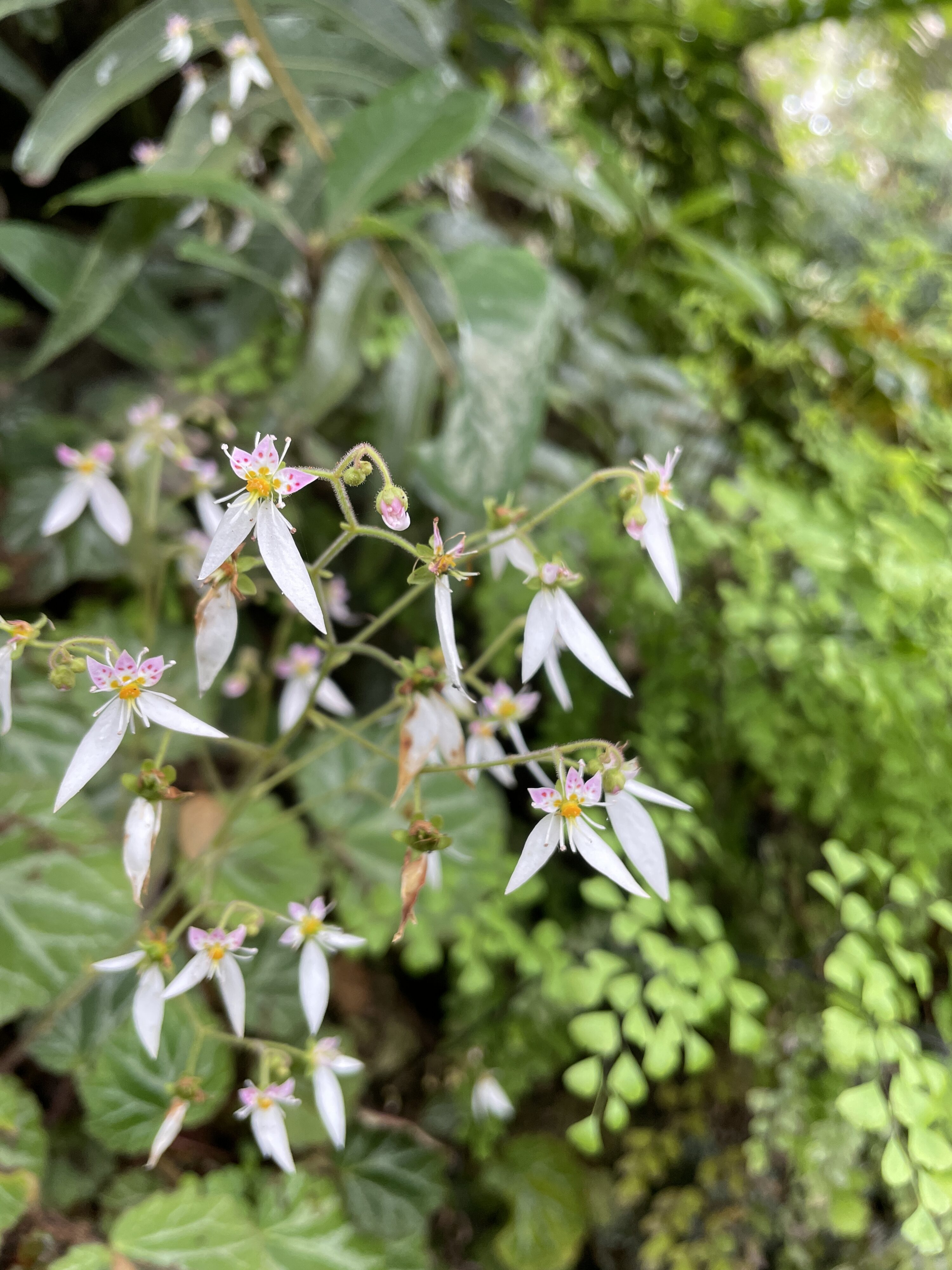
The fuzzy leaves are a lovely deep green with flashes of silver venation and pinkish-red undersides. Each leaf extends from the basal rosette on a reddish petiole. In late spring and early summer, breezy panicles of white and pink flowers adorn the plant. The individual flowers have three pink upper petals and two larger white lower petals. The flowers stand about 12-18” above the leaves. S. stolonifera spreads via reddish stolons tipped with small plantlets. Consider growing the plant in a hanging basket where these can be displayed.
Where at Lotusland:
Visitors can find the plant in the Fern Garden, clambering over tufa stones and creeping along the ground.
-
Aloe sabaea
Yemen tree aloe
Highlight Month:
March
Nativity:
It is found in southwest Saudi Arabia and western Yemen and grows in a wide distribution on dry, rocky open hillsides.
Growth Habit:
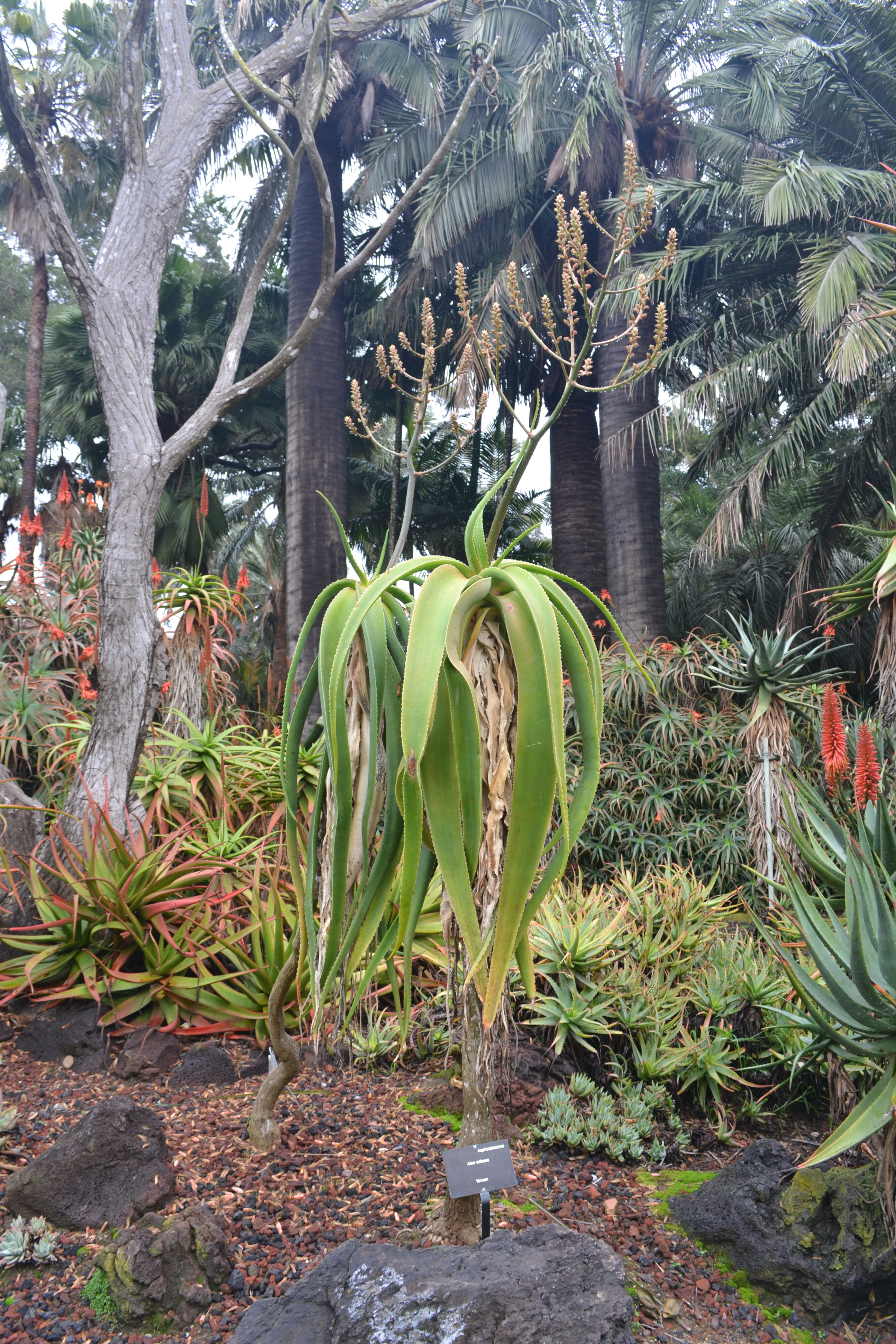
Aloe sabaea is the tallest aloe from the Arabian Peninsula and its unbranched trunk can reach heights of 9-12 feet. Three-foot-long pale green leaves with small white marginal teeth emerge in drooping side-facing rosettes, imparting a melting appearance to the entire plant. When damaged, the leaves ooze a clear exudate smelling strongly of rat urine, indicating the presence of toxic hemlock alkaloids. This species blooms in mid-winter with coral orange flowers held on a branched inflorescence. Yellow-flowered forms exist but are rare in cultivation.
Growing Requirements:
Full sun, well-drained soils, hardy to 27°F
Features:
The specific epithet sabaea comes from the name for an ancient group of South Arabian people, the Sabaeans, who founded the Kingdom of Saba (800-400 BCE), in what is now present-day Northern Yemen and the Asir Province of Saudi Arabia. Researchers at Kew Gardens speculate A. sabaea evolved from a radiation event of Aloe into the Arabian Peninsula about 5 million years ago.
Where at Lotusland:
Aloe Garden

-
Veltheimia bracteata
forest lily, cape lily, boslelie
Highlight Month:
March
Nativity:
southeastern South Africa
Growth Habit:
Veltheimia bracteata is a winter-growing bulb from southeastern South Africa. In habitat, it grows in coastal dune forests under tree canopy in full to part shade and receives both summer and winter rainfall. It flowers in the spring with a one-foot tall inflorescence bearing tubular bubble-gum pink flowers and many yellow and pastel-flowered forms exist in the trade. V. bracteata can be propagated from bulb offsets, or from seed which form in three-winged papery capsules.
Growing Requirements:
V. bracteata undergoes a brief period of summer dormancy before the glossy green leaves reemerge in the fall/winter. In cultivation, it is best to cut back on summer watering to prevent the bulb from rotting. This species is hardy to USDA Zones 9b-11.
Features:
The genus only contains one other species, Veltheimia capensis, from winter-rainfall regions of western South Africa. This species is adapted to full sun, has bluish-gray leaves, and flowers in the fall/early winter. Both species are pollinated by birds. The genus name honors August Ferdinand von Veltheim, a German mineralogist and geologist (1741-1801).
Where at Lotusland:
Fern Garden

-
Zantedeschia aethiopica ‘Green Goddess’
Green Goddess calla lily
Highlight Month:
March
Nativity:
Garden Origin
Growth Habit:
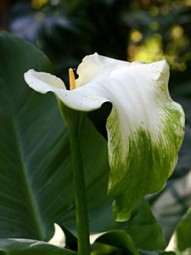
Calla lilies are evergreen in moist sites in the Santa Barbara area, although they can return from their drought-dormant tubers quite successfully once fall rains have begun. Their large leaves, 1 ½ to 2-foot blades atop 3-foot stems are arrowhead shaped. They begin blooming in very early spring with tall stalks rising above the leaves. The cultivar ‘Green Goddess’ has a funnel-shaped spathe surrounding the familiar yellow spadix that shades from pure white in the center to an elongated tip striped with emerald green.
Growing Requirements:
Calla lilies naturally grow in bogs, so constant moisture is required to keep them year round. Bright shade or filtered light promotes vigorous growth and good flower production. They may even be planted in shallow water in ponds.
Features:
This cultivar is larger than the regular calla lilies and provides a lush, tropical look to the shade or water garden.
Where at Lotusland:
Fern Garden

-
Aloe speciosa
tilt-head aloe
Highlight Month:
March
Nativity:
South Africa
Growth Habit:
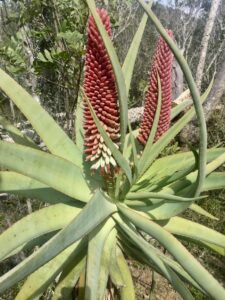
This arborescent aloe grows to 15’ or more with a single rosette of grayish-green leaves atop an attractive “skirt” of older leaves. The rosette usually tilts toward the direction of the greatest sun exposure. The large, unbranched inflorescences have deep pink buds that mature to greenish white flowers with reddish brown stamens.
Growing Requirements:
Aloe speciosa is very easy to grow. It requires full sun and good drainage. Water only to get plants established. It is hardy to 25 – 30 degrees Fahrenheit.
Features:
This is one of the later aloe to bloom at Lotusland.
Where at Lotusland:
Along the Main Drive near the Sycamore Canyon Gate and in the Aloe Garden.

-
Grevillea paniculata
kerosene bush
Highlight Month:
March
Nativity:
Southwestern Australia
Growth Habit:
A woody shrub up to 3 feet in height that can spread 10 feet or more in width. Very drought tolerant, it makes a soft-looking mound of light green, fine-leaved foliage.
Growing Requirements:
Full sun, no supplemental water once established.
Features:
The narrow leaves are deceptively soft-looking. In actuality, they have sharp tips that can cause dermatitis. Wear long sleeves and gloves when working with this plant. In spring, it is clothed with clusters of small white flowers.
Where at Lotusland:
In the Australian Garden around the parking lot.
-
Salix babylonica
weeping willow
Highlight Month:
March
Nativity:
Northern China
Growth Habit:
Weeping willow trees grow rapidly to as high as 50 feet. The pendant branches form a fountain fo greenery with leaves touching or nearly touching the ground enclosing a canopy nearly as wide as it is high.
Growing Requirements:
Full sun and regular moisture; it favors wet sites at the edge of natural waterways.
Features:
This tree has been widely cultivated for thousands of years for its graceful shape. It can be a focal point in the appropriately large and moist site. The bright green leaves emerge in early spring.
Where at Lotusland:
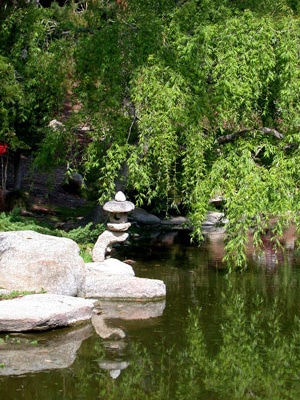
In the Japanese Garden at the edge of the pond.

-
Tillandsia usneoides
Spanish Moss
Highlight Month:
March
Nativity:
Southern United States, Central and South America
Growth Habit:
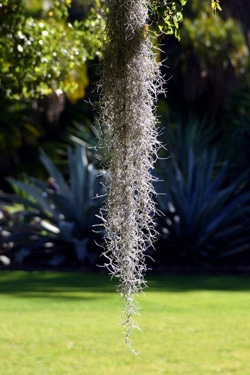
This bromeliad is one of the “air plants” that simply hang from trees, shrubs or even manmade structures. It takes all its water and nutrient requirements directly from the air with the help of specialized hairs called trichomes. The leaves are very thin and thread-like and tiny flowers may be observed in summer (a hand lens can help).
Growing Requirements:
Spanish moss grows naturally where temperatures are mild to warm and humidity is high. Frequent misting is required to grow it in naturally arid environments.
Features:
The silvery gray foliage can festoon trees in a garden setting. It has historically been used as a stuffing in cushions and pillows.
Where at Lotusland:
Throughout the bromeliad gardens.